Statute of Limitations for Personal Injury Cases
In California, personal injury lawsuits must generally be filed within two years of the injury. Learn how the deadline works and request a case evaluation.

Individuals who have suffered a personal injury in Los Angeles or in other Californian city are advised to take action as soon as possible. This is because the California laws impose certain limitations on filing claims in a personal injury case.
Depending on your case, you can get in touch with us through the form and discuss your situation.
What is a statute of limitations according to the Californian laws?
The simplest definition of the statute of limitations is the timeframe in which a plaintiff, in this case, an individual who has suffered a personal injury in Los Angeles or anywhere else in California, can file a claim and initiate a lawsuit for the accident suffered. Personal injury cases in Los Angeles fall mainly under the California Code of Civil Procedure (for example §335.1 for personal injury and §340.5 for medical malpractice).
Depending on the accident suffered, it is best to ask Los Angeles personal injury lawyers to review the case and the statute of limitations it falls under to know how to proceed to obtain the best outcome and the right compensation.
Below you can watch a short video on the statute of limitations:
What is the statute of limitations for personal injuries in Los Angeles?
The usual statute of limitations for a personal injury case in California is two years. However, there are situations, like personal injuries caused by medical malpractice which take time to be noticed.
Medical malpractice cases have a statute of limitations of one year after the discovery of the injury or three years from the date of the injury (whichever comes first). The three-year limit is extended (tolled) for fraud, intentional concealment or a foreign object, such as a sponge or instrument, left in the patient’s body (CCP §340.5). A medical malpractice lawyer in Los Angeles can answer your questions. You can read more about this issue in the paragraphs below.
This special “discovery of harm” rule, as it is called, allows the plaintiff to file a lawsuit against the defendant within a year from discovering the injury. The one-year discovery period is specific to medical malpractice, but a delayed-discovery rule (which postpones the start of the normal limitation period) may be used in other personal injury situations in which the plaintiff was unaware of an injury sustained in an accident until a later date. Mothers who have suffered birth injuries in California must generally present a written claim within 6 months after the claim accrues if the hospital is operated by a public entity, such as the state or a county (Gov. Code §911.2). Another exception is if the plaintiff (the injured person) is a minor. In this case, the limitation period is generally paused until the plaintiff turns 18 (CCP §352), with stricter special rules for minors in medical malpractice cases (CCP §340.5).
The special discovery of harm rule can apply only when the victim is able to clearly link the injury to a past accident. Medical records are very important in this case. The medical treatment needed immediately after the accident as well as future medical care may be compensated for if the plaintiff can prove that the injury was linked to the accident.
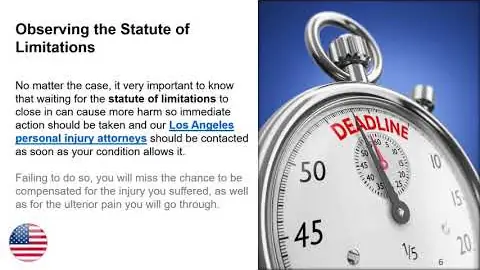
No matter the case, it very important to know that waiting for the statute of limitations to close in can cause more harm so immediate action should be taken and a personal injury attorney should be contacted as soon as your condition allows it. Failing to do so, you will miss the chance to be compensated for the injury you suffered, as well as for the ulterior pain you will go through. Moreover, plaintiffs who fail to bring the case to court before the end of the statute of limitations may encounter another risk: the defendant may take advantage of the late filing and use it as a defense.
In some cases, the California statute of limitations may be extended. Such examples include:
- if the plaintiff is a minor;
- if the defendant was not in the state of California for a certain period of time;
- if the plaintiff serves military services or a prison sentence.
You should always consult with a personal injury lawyer if one of the above situations apply, in order to determine how and if these cases influence the statute of limitations period. For assistance or more information on the statute of limitations in California, please contact us through the form.
Responsible attorney: Marc Y. Lazo, Esq., State Bar of California No. 215998 · Last updated 29 October 2026